
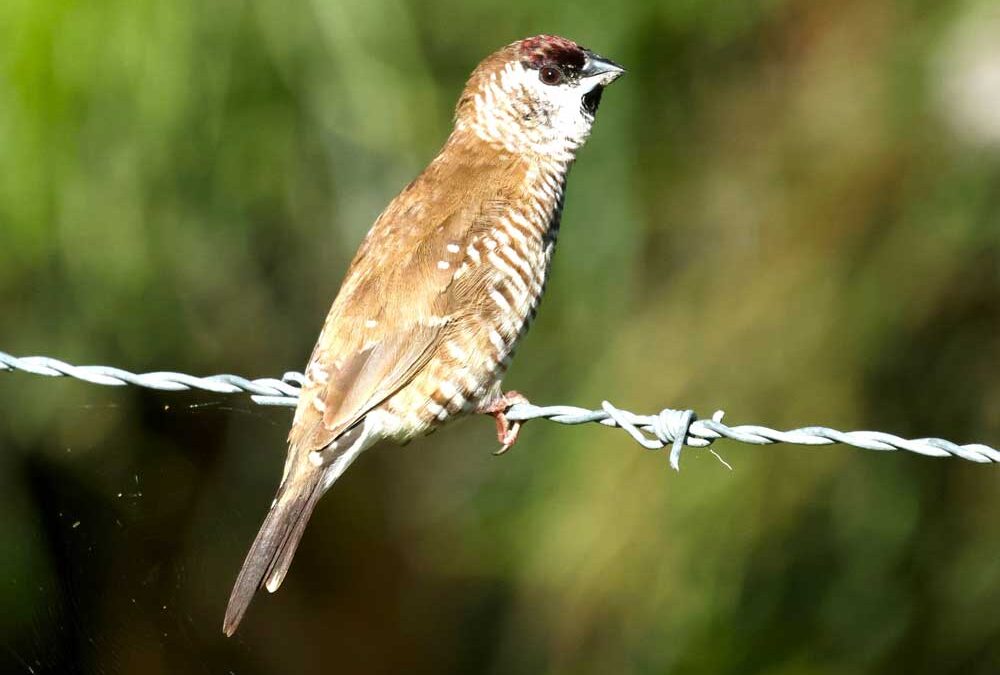
The male Plum-headed Finch is quite a handsome bird (Tom Tarrant)
Rare Plum-headed Finches seen at the Eco-Corridor
As mentioned in our regular article in this edition, our birdwatchers were very excited to find a small group of four Plum-headed Finches feeding on seeding grasses near the NPWS buildings in the Samford Parklands during our latest survey on 20 May. This is a species that usually lives west of the D’Aguilar Range in places like the Lockyer Valley and is classified as rare in the Moreton Bay Local Government Area. A couple of Plum-heads turned up recently at Graham’s Road Reserve, Strathpine and another seven were seen at Day’s Road West Reserve, Wights Mountain (where they had been seen once before in 2022). It is likely that these nomadic birds moved eastwards at the end of the very dry summer in search of better food resources.
This small finch has brown upperparts with white spots on the wings and cream underparts with fine brown barring. The male has a black facial mask, small black bib and a distinctive iridescent maroon cap. The plainer female has a smaller black mask, a cream ‘eyebrow’, less maroon on the cap and lacks the black bib.
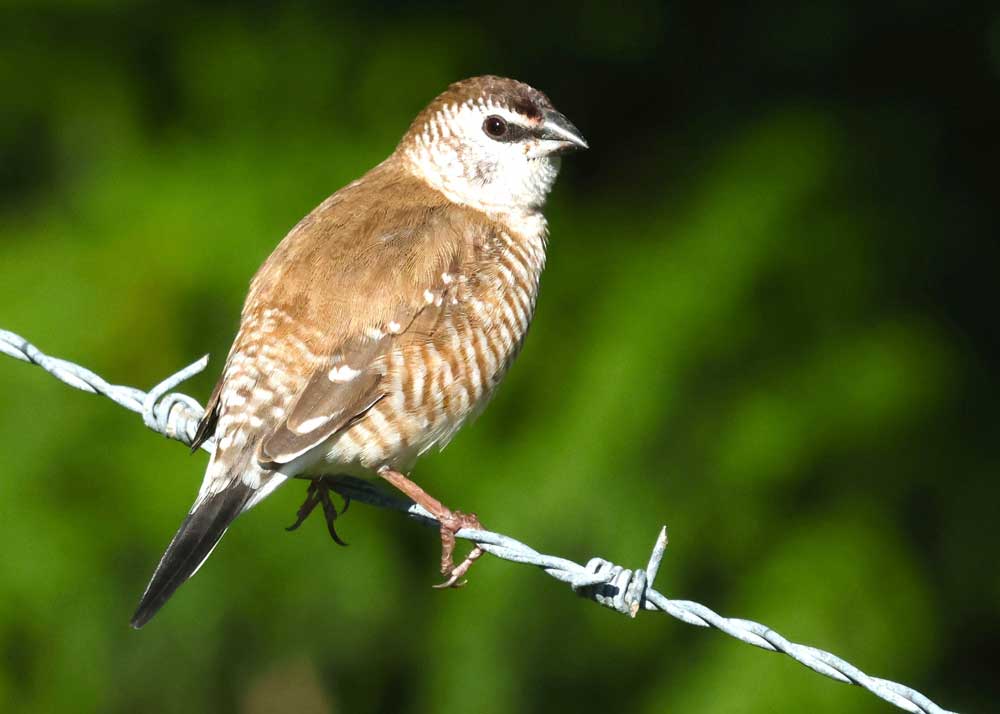
The female is plainer (photo: Tom Tarrant)
Plum-heads usually occur as pairs or small groups, often associating with other finches (at the Eco-Corridor they were feeding with Double-barred Finches and at Days Road West Reserve they were with a flock of about 60 Chestnut-breasted Mannikins). They are usually found near wetlands, such as swamps, marshes, waterholes, watercourses and dams. They occur from Bowen in Queensland to the NSW tablelands, mostly west of the Great Dividing Range. They feed on grass seeds by either foraging on the ground or among the seed-heads.
Most breeding takes place from September to January, but can occur at other times in favourable conditions. During courtship, the male carries a piece of grass in his bill, lands near the female and hops or sidles towards her. He then begins singing without opening his bill and slowly bobs up and down without letting go of the perch. The bulky domed nest made of grasses has a side entrance and may be lined with feathers. The usual clutch size is 3 to 7 eggs. The young are fed and brooded by both parents, with a fledging period of about 21 days.
Let the Village Pump know if you see this bird in the Samford district over the next few weeks.
Peter Storer