
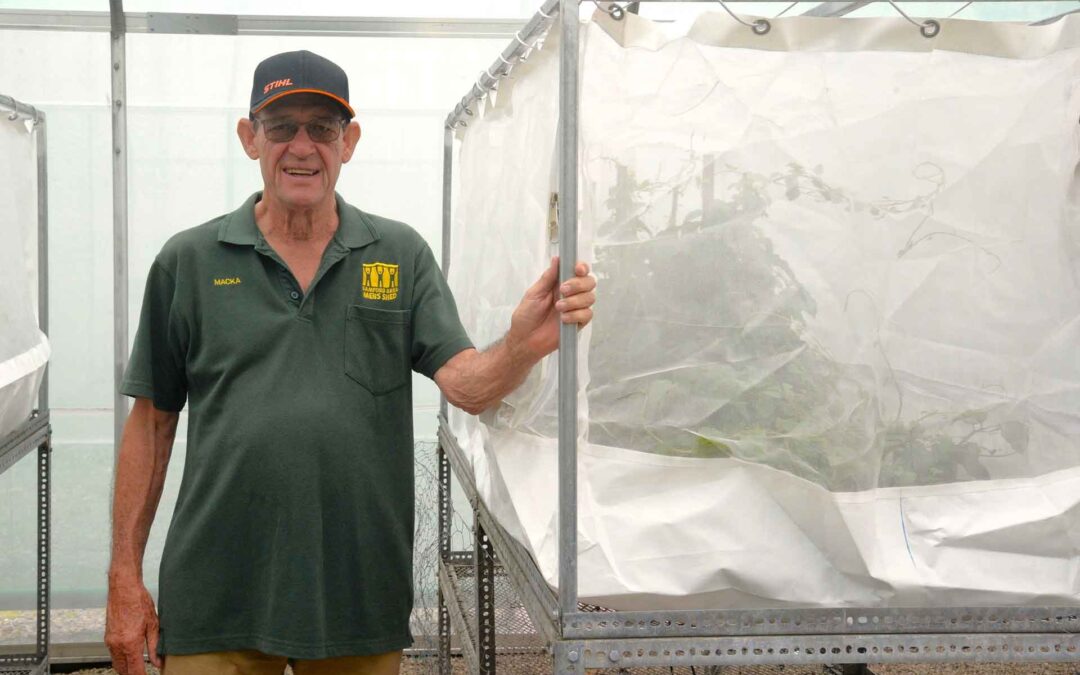
Macka with a ‘bug dorm’ built by the team at the Samford Area Men’s Shed
On 31 March, City of Moreton Bay Council Mayor, Peter Flannery, and the Qld Minister for the Environment, Tourism, Science and Innovation, Andrew Powell, launched the Samford Biological Control Facility in the grounds of QUT SERF at Camp Mountain, with TV Channels 9 and 10 in attendance. The new facility, run by the Pine Rivers Catchment Association (PRCA), will breed thousands of small beetles and bugs to be unleashed as biological control agents to combat two of South-East Queensland’s most destructive invasive weeds: Madeira Vine and Cat’s Claw Creeper. These fast-growing vines from South and Central America completely smother native vegetation, particularly along our creeks and rivers, seriously degrading the habitat. Biological control of these weeds reduces the need to use herbicides along our sensitive waterways.
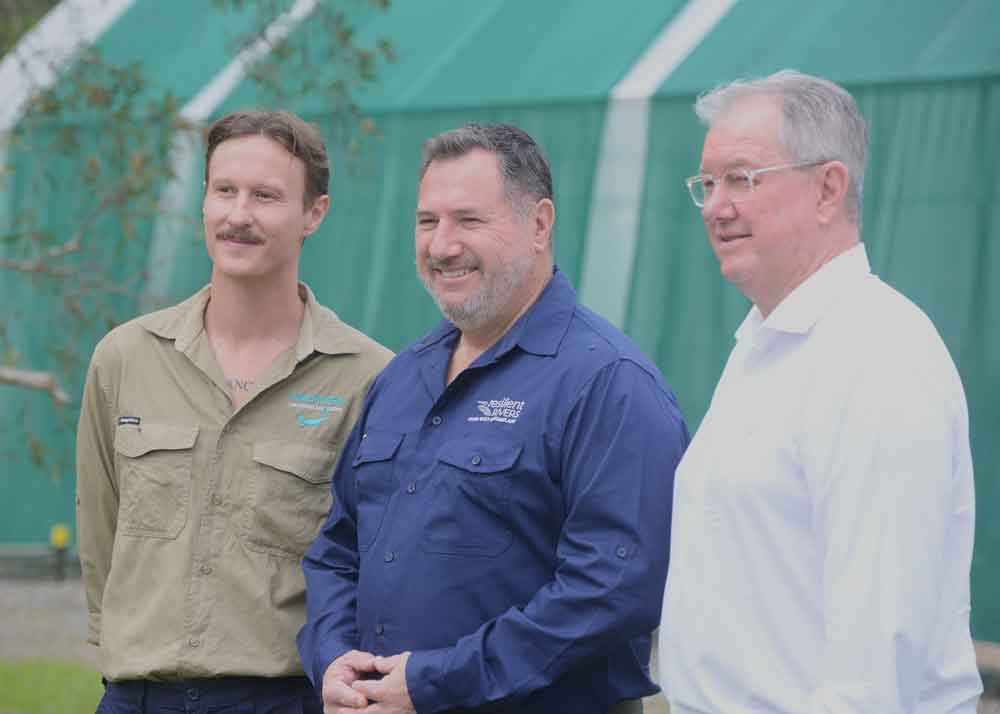
PRCA Operations Manager Dan Pagotto with Minister Powell and Mayor Flannery
The tiny heroes to be bred and released are the Madeira Vine Beetle (Plectonycha correntina) to control Madeira Vine, and the Leaf-mining Jewel Beetle (Hylaeogena jureceki) and the Leaf-sucking Tingid (Carvalhotingis visenda) to control Cat’s Claw. These insects and their larvae weaken the vines by eating the leaves or by sucking chlorophyll from plant cells. Biosecurity Queensland has vigorously tested all three insects to confirm that they are host-specific and pose no threat to native plant species.
The insects are housed in a large shade structure in the pasture section of QUT SERF in which there are smaller ‘bug dorms’ where they breed. Ian McPherson (Macka 2) from the Samford Area Men’s Shed said: “My team at SAMS is very proud to have constructed the ‘bug dorms’ for this important environmental initiative. It is a wonderful example of collaboration by local groups.”
PRCA Operations Manager Dan Pagotto expertly answered many questions from the media, such as how many young does each pair of insects produce (about 100), how many will be released (tens of thousands) and at what time of year (spring is ideal).
The biological control project is funded for 2 years ($400,000) through the Resilient Rivers (SEQ) program. This is a joint initiative of the Council of Mayors (SEQ), the Queensland Government, SEQ Water and the Federal Government, with each contributing $10 million toward restoring waterways from the Noosa River to the Albert River. The balance of the Resilient Rivers funding will be used to: help landowners rehabilitate and maintain river frontage to reduce erosion (preventing 16,000 tons of sediment from entering local waterways); plant 200,000 plants across 116 hectares; undertake eDNA sampling to monitor threatened species such as the platypus; run educational workshops; remove barriers preventing fish from migrating upstream to breed; create 200 underwater ‘hotels’ for the critically endangered Mary River Cod; and raise cod fingerlings for release into the Mary River catchment.
Peter Storer