
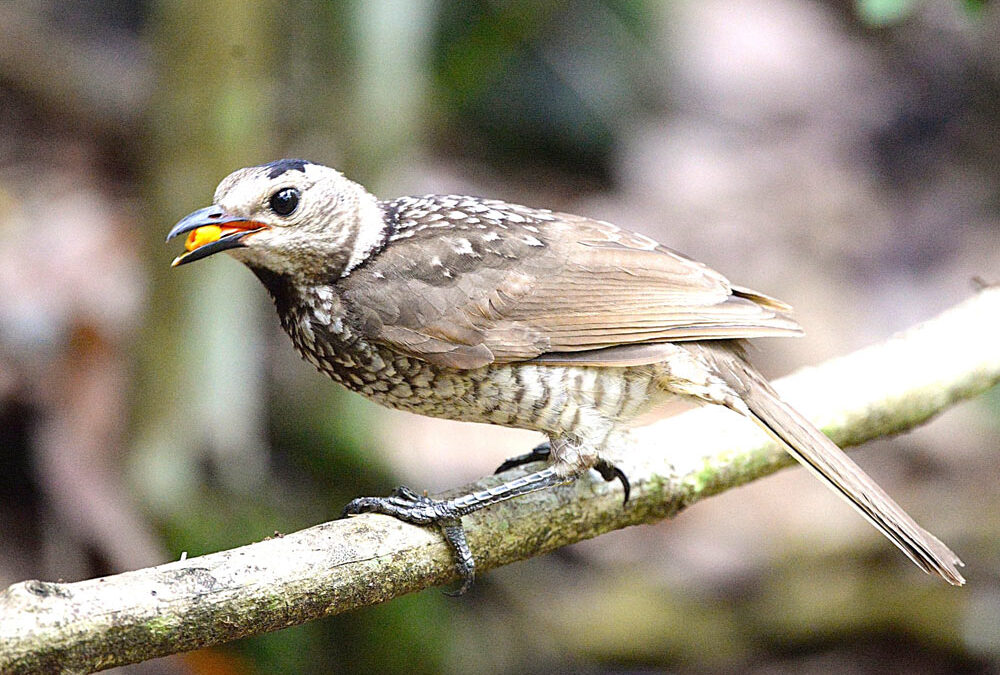
Female Regent Bowerbird (Sericulus chrysocephalus)
The iconic Regent Bowerbird is usually considered to be an upland subtropical rainforest species. In South-East Queensland it is mainly found in D’Aguilar National Park, the Sunshine Coast hinterland, Mount Tamborine, Bunya Mountains, Springbrook NP and Lamington NP, where it is incorporated in the logo of world-renowned O’Reilly’s Rainforest Retreat. Locally, Regent Bowerbirds are found in the rainforests of Mounts Nebo and Glorious, but did you know that in the winter months some birds come down to riparian and woodland areas of the Samford valley, particularly along the South Pine River and Cedar Creek, as do some Satin Bowerbirds and Noisy Pittas? These are examples of altitudinal migration.
The adult male is one of the world’s most stunning birds with a slender jet-black body, bright yellow primaries and secondaries and even brighter flame yellow crown and hindneck, and yellow iris. The larger, plainer female is mainly brown above with flecks of white on the back, paler below with dark scalloping on the breast and finer scaling on the belly, with black patches on the back of the neck and middle of the throat. Juveniles of both sexes resemble the female, but with softer toned plumage. The male takes 6 years to develop full breeding plumage and can look quite ‘messy’ in its intermediate plumage from years 4 to 6.
In the early 1900s, numerous Regent Bowerbirds were killed to supply feathers for the millinery trade in London, and some were exported to England as cage birds. Today the biggest threat is habitat loss, although much of our remaining rainforest is protected in national parks and other reserves.
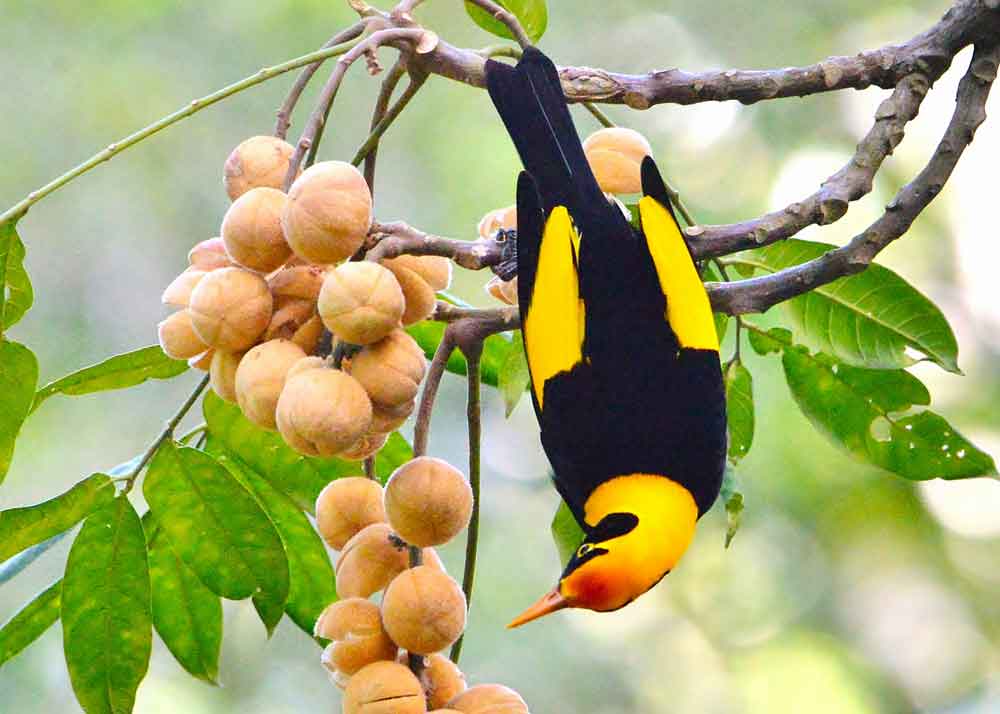
A male Regent Bowerbird feeding on Hairy Rosewood at Mt Glorious. The female Regent Bowerbird is larger and plainer.
In subtropical rainforest, the Regent Bowerbird feeds on fruit and arthropods, often in the upper strata or canopy, but will occasionally take nectar from flowers or come down lower to eat the fruit of native raspberries. While wintering at lower altitudes, they may also feed on low shrubs, such as the female observed feeding on the pale-yellow fruit of Psychotria loniceroides at the Eco-Corridor in 2022.
The male builds a terrestrial bower (an avenue of sticks), which he decorates inside with leaves, flowers, petals, snail shells and fruits. This is where courtship and mating take place. These structures are temporary, often being destroyed by rival males. Males are promiscuous, often mating with a few females each season. The female builds a flimsy cup-shaped nest high in a tree and typically lays 2 eggs, which she incubates and raises the chicks alone (breeding is typically in November and December). The Regent is one of the quietest bowerbirds, rarely calling away from the bower.
Keep your eye out for this special bird in the Samford district over the cooler months.
Peter Storer